Archive for the 'General update' Category

Random thoughts

Thursday, December 28th, 2006

I’ve been thinking about starting a new type of post on this blog: shorts posts with fairly random thoughts. For the most part, I don’t have time for long elaborate posts, but on occasion I do have random thoughts that would be fun to write down and perhaps of interest to the E-Blog fans who keep coming back despite the infrequently updated content around here. So if you see a “Random thought” headline, you’ve been warned.

Gift guide: supporting the long tail

Thursday, December 14th, 2006

In the spirit of supporting the long tail, I thought I’d link to a few nifty items you likely won’t find in stores, but that are just as worthy as many of the items that are backed by big marketing budgets.

I found the booklet “Why Mommy is a Democrat” one day by clicking on a sponsored link in GMail (the line just above the message area). I liked the idea of communicating a message of this sort to little kids so I ordered a copy. I like the way the author and illustrator approached the topic. The idea of self-publishing something of this sort is also interesting. I purposefully use the word booklet instead of book despite the information on the site. The “book” feels more like a booklet. That doesn’t detract from its value. I mention it in the interest of realistic expectations. Cost: $10 including shipping in North America (with some possible savings for bulk orders).

On a different note, I highly recommend the California Soups and Salads 2006-07 Academic Calendar by Susan Beach. It covers September, 2006-December, 2007. Each month comes with a very inviting photo of a wonderful soup or salad dish plus its recipe on the side. Susan is our resident chef here at the Center and is an amazing cook. This could be a great gift for a myriad of people. Cost: $10 including shipping.

Moving on, I found the jams and jellies maker McKenzie’s Own at a summer fair last year and thought their products were divine. I bought two spreads: Mom’s Horseradish Spread and the White Chocolate Raspberry Spread. Both were great. Cost: $6.50 each plus $6.00 shipping.

I only have experience with online ordering regarding the first product, the others I bought in person. Full disclosure: I have no financial interest in promoting these products, I bought them and liked them, that’s all there is to it. I do know Susan personally though.

The site Etsy hosts lots of independent sellers although some of the products there tend to be on the expensive side. Of course, one can also find independents on ebay and on various corners of the Web. But what are those corners? Do share your favorites, I’m always curious to find the hidden gems.

This is second in the Gift guide series. Next week: giving through donations.

Video round-up

Saturday, November 25th, 2006

Here are some interesting video finds:

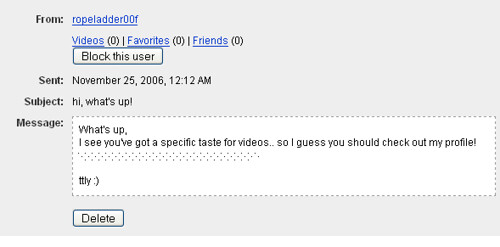
Also, as proof that YouTube has grown up, I am now receiving spam through it:

My first YouTube spam

Since the sender’s ID wasn’t created until five days before sending this note and the account has no bookmarked or submitted videos, it’s a safe bet (beyond the content of the message) that its sole function is to generate spam. (I have purposefully removed the URL the user is trying to advertise from the above image.)

Project 365: #24

Sunday, November 19th, 2006


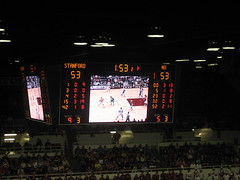
NU ties Stanford

Taken: November 17, 2006 (What is Project 365?)

Northwestern played Stanford in basketball yesterday. These two schools don’t play each other much so it was a special treat to have the ‘Cats in town. Although NU lost, they played a good game. It was one of the most fun ones I’ve seen them play actually. I honestly believe if it hadn’t been for the home court advantage, the outcome would’ve been different. But the way Stanford’s stadium is set up the students stand along half the court and are quite a presence. Weird element of the game: the Stanford redwood dancing mascot (?). What’s up with that?

And no, I don’t plan on making basketball court photos a regular on Project 365.

Credit Slips blog

Friday, November 3rd, 2006

Credit Slips is a group blog focusing on “all things about credit and bankruptcy”. Not only does this blog have a great list of contributors, but they also bring in some star guests.

This week, Viviana Zelizer from Princeton’s Sociology Department has been guest blogging on topics ranging from the importance of personal ties in economic transactions to economic exchange across generations in families, the gendered aspects of spending and the intersection of economic transactions and intimate relations. (The latter is also the topic of her most recent book on The Purchase of Intimacy). She is great at talking about these issues so I highly recommend checking out her posts.

Full disclosure, Viviana was one of my mentors in graduate school. However, I think that makes me particularly qualified to comment on how helpful her work is in understanding questions about how social relations and cultural context influence economic processes. Be sure not to miss out on this treat.

Kindred spirits

Wednesday, November 1st, 2006

My office for the yearIn honor of Halloween, the staff at the Center gave each fellow a list of previous office occupants. (As a reminder, I’m spending the year at CASBS thanks to a grant from the Annenberg Foundation to bring communication scholars here.) Below is my list of ghosts from the past.

Bay, Christian
Bauer, Raymond
Opler, Morris E.
Hymes, Dell H.
Beattie, John H. M.
Heady, Earl O.
Cohen, Albert K.
Millon, Rene
Shaffer, Jerome A.
Jenkins, James J.
Tannenbaum, Percy
Lydall, Harold F.
Mandelbaum, Maurice
Kothari, Rajni
Barber, Cesar L. Joe
Hartz, Louis
Mazrui, Ali
Neisser, Ulric
Peterson, Osler
Said, Edward
Cohen, Ronald
Graves, Theodore
Vaillant, George
Goody, Esther Newcomb
Dawes, Robyn M.
Watson, Richard Allan
Kaestle, Carl F.
Prewitt, Kenneth
Scott, Rebecca J.
Cawte, John
Weber, David J.
Lougee, Carolyn Chappell
Nipperdey, Thomas
Ashenfelter, Orley
Hermalin, Albert I.
Meinwald, Jerrold
Palloni, Alberto
Weber, Elke U.
Lerdahl, Fred
Camarillo, Albert M.
Trouillot, Michel-Rolph
Green, Martin B.
Rév, István
Cook, Karen S.
Twining, William Lawrence
Grimshaw, Jane
Biernacki, Richard G.
Gruenfeld, Deborah H.
Fisher, Philip
Katzenstein, Mary F.
Katz, Jonathan N.
Hargittai, Eszter

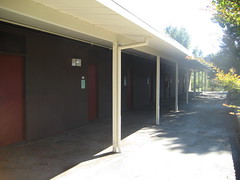
My It may seem silly to focus on individual offices, but given the special architecture of this place, each office is a distinct part of the Center. Its architect William Wurster did a wonderful job of constructing a place that offers considerable privacy to each office occupant while also fostering interaction among community members. Perhaps some of the pictures I have taken convey that. There are no hallways here, just rows of offices and gardens in between.

Being given an opportunity to be at the Center is already humbling enough, but to think that all of the above people had been in the exact same spot working away is quite amazing. It’s neat to find some connections. For example, I only brought a few dozen books with me to the Center, but one of them is Carl Kaestle’s Literacy in the United States so it was really fun to see his name on my list.

I could spend days browsing the lists of the various offices, there is so much exciting history here.

Got three minutes?

Friday, October 27th, 2006

Click here for something cool.

in three minutes, the largest dot will travel around the circle once, the next largest dot will travel around the circle twice, the next largest dot three times, and so on.

the dots are arranged to trigger notes on a chromatic scale when they pass the line

[thanks]

1956

Monday, October 23rd, 2006

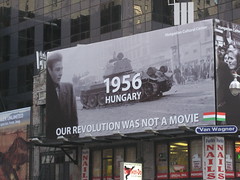
Our revolution was not a movie Fifty years ago today events occured in Budapest that quickly led to the death of many and the emigration of about 200,000 Hungarians to various corners of the world. (Considering a country of 10 million, that’s a significant number.)

Having grown up in a system that didn’t recognize this day as worthy of mention (given that its whole point was to topple the Soviet-influenced regime) I have never had much of a connection to it. And having left Hungary soon after the political changes of the early 90s after which the date became officially important and a holiday, I have never developed much of a bond with it. In fact, I’m more likely to recognize November 7th as a special date (the one Hungarians and others in the region used to celebrate) than October 23rd. All that is a testament to how strongly social context can influence one’s perception of important historical events and dates.

The image above is from the Times Square area in New York City. I was walking down Broadway on Saturday and noticed the red-white-and-green lines. I figured it was a mistaken use of the Italian flag. When portrayed horizontally, the Italian flag has to be green-white-and-red in order not to be confused with the Hungarian flag. But people unfamiliar with the Hungarian flag (which would be most of the world) don’t know this and so I sometimes see the Italian flag portrayed that way. However, as I neared 50th St. I realized that this was meant to be a Hungarian flag. The Hungarian Cultural Center put up two huge billboards on the corner of Broadway and 50th to commemorate the occasion and to invite folks to “REimagine freedom“.

And yes, there has been unrest in Budapest during the past few weeks including some events today. Some people are trying to draw parallels to the events of 1956, but that seems ludicrous. Just because some people – mostly on the far right so you are not going to see sympathies from me – who are especially good at inciting a few hundred folks do not like the current regime doesn’t mean the prime minister needs to be ousted. (I commented on all this a few weeks ago.)

GMail ads

Friday, October 13th, 2006

Remember all the concerns about GMail reading people’s emails with the goal of displaying targeted ads? I was among those expressing reservations back when the service was first introduced. I continue to believe that it is important to be generally conscious about how much of our email and other activities are stored and potentially analyzed by Google and other service providers. Nonetheless, it’s also interesting to pause on occasion to see the level of sophistication – or lack thereof – that some of these services have reached nowadays.

Sometimes I am surprised by how well the ads on the sidebar match the content of my messages. For example, from very little text, GMail seems to be able to tell if a conversation is conducted in another language and serves up ads consistent with the language of the correspondance (here I’m referring to some experiences with Hungarian).

Today, however, I was reminded that there is still considerable room for improvement in the system. I am in the midst of corresponding with some friends about an evening outing consisting of drinks and dinner and possibly dancing. There is no information in the messages about the location of all this (even at the city-level) so it’s hard for the ads to be targeted in that way. Our email addresses either end in gmail.com or educational institutions scattered across the country so even if GMail analyzed that information, it wouldn’t help in this case. We also haven’t mentioned any restaurant names to provide clues.

There is one piece of specific information that has come up, however: “I’m flexible (except the usual Thai food allergy problem).”

Given this note, it was curious to see a link to “Thai Restaurant Iowa”. The word “allergy” is right next to “Thai food” in the above sentence. So what are the chances that information about Thaid food restaurants is going to be of interest?

Road trip highlights

Sunday, September 17th, 2006

Now that I’ve posted all of the photos from my drive West, I thought I’d point out some of the trip highlights. (Unfortunately, the photos are not in order and it would be too much work to get them rearranged. Oh well. UPDATE: I just realized it’s not necessarily that much work thanks to Flickr’s Organize feature. I’ve rearranged some of them, but with others, I just don’t quite remember anymore and the photo time stamps seem to be off.:()

For the geographically challenged (or those simply not familiar with this part of the United States), driving from Evanston, Illinois to Palo Alto, California requires crossing the following states: Illinois, Iowa, Nebraska, Wyoming, Utah, Nevada and California. Most of these states are incredibly long (that is, they have a wide east-west stretch), especially for someone who’s more used to the eastern part of the United States. Of course, you could also cross all sorts of other states while heading west (say, go north through Wisconsin, Minnesota, etc.), but I needed the quickest route, which is supplied by Interstate 80.

Hail storm in Iowa I’ve tried to pick a highlight for each state, but it’s not always obvious given that I didn’t have time to make detours with sightseeing purposes. In Iowa, the hail storm was the big event and I managed to capture a few photos, although they really don’t do it justice. It was much scarier and harder to navigate than it seems. I also neglected to take photos of the line of cars standing out on the shoulder of the highway waiting for the storm to pass. Of course, the twist in such a situation is that you likely get out of the storm quicker if you keep on driving, unfortunately, it’s practically impossible to drive when you’re in the middle of it. So that took a bit of time.
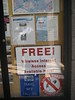
Free wifi at all Iowa I-80 rest stops An unrelated interesting aspect of Iowa was the free wifi that was advertised at every rest stop. I’m surprised that I’ve never heard Jeremy talk about this, it seems like the kind of thing he’d be proud of about his home state. I didn’t have time to try out the free wifi, but it sounded like a very nice feature to offer travellers. This nice service didn’t show up anywhere else on the trip.

The next notable experience occured in Nebraska where a crazy pilot nearly landed a plane in the middle of the highway. I wouldn’t call the pilot crazy if it had been a true emergency situation, which it seemed at first. But having seen the plane nearly land I followed its path to note that it got right back up in the air, made a loop, and then came right back to the highway. What a nutcase! I wish I had photos, but it was all too sudden to grab the camera. Sudden and scary.
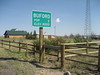
Population: 2; Elevation: 8,000 The highlight in Wyoming was Buford, population: 2, elevation: 8,000 feet, as I described earlier. I honestly had absolutely no idea how high up we were until I saw the sign. As a commenter over on Crooked Timber noted, eastern Wyoming is part of a very large plateau and that’s why one doesn’t feel the ascent so much. This map helps with visualization.

The last town in Wyoming on I-80 before reaching Utah is a town called Evanston. That was funny. After having been on the road for so long, it was a little confusing to think I hadn’t left at all.
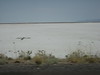
Cross in the salt fieldThe notable aspect of Utah was all the salt. Let’s just say I don’t think we’ll be facing a salt shortage any time soon. It was just unbelievable amounts of salt mile after mile after mile. Here’s some that seems to be in production already, and here (link to large version) you can even see the Morton Salt girl from the company’s logo.

I noticed that there were stones in the salt fields making up signs, symbols and words. These went on for many many miles. Here’s a cross in the salt. I didn’t manage to capture any of the writing, but it was usually names of people, “Mary”, “Jim”, etc. with the occasional heart. I wonder who put these there. There is an Air Force base or two in the area, perhaps they’re from military folks. There are no towns around so it’s really hard to tell, and it’s a bit hard to imagine people driving cross country stopping their cars to make one of these, but I guess that’s possible as well.
Way long road ahead... An additional memorable aspect of the trip here was the incredibly straight line of driving. Check out the map. It is not an exaggeration. There was barely a curve in the road. The only thing that breaks up this photo is the train above the highway.

Crossing from Utah into Nevada was very interesting. There is a town right on the border (which I guess then makes it two towns: Wendover and West Wendover) and there’s a mark on the pavement (not the highway, just in the town) signaling the border. I didn’t manage to capture that. Nor did I take photos of the two towns despite the very interesting difference between the two. Clearly you’d crossed into casinoland by taking that step, it was impossible to miss.
Rest stop In addition to the Casinos, the only other memorable part of Nevada was the change in scenery, finally. It took a while, but eventually there was some elevation and some trees again, which was refreshing.

The road from Nevada crosses into California right around Lake Tahoe so immediately the traffic picked up. There was also much more vegetation, and very pretty at that. The descent was unbelievably steep at times, somewhat stressful, in fact.

As proof of how much the pressure changed from the Western border of California in the Lake Tahoe region to the Eastern part of the state in the Bay area, check out the difference betwen these two pictures of the same bottle, before and after opening it at the end of the trip:


Water bottle after descent     Water bottle now opened

Not long after came the many-lane highways and bridges, welcoming me to my home for the next nine months.
Long trainOther random observations throughout: I got a kick out of following the railroad at various points in the trip. There were unbelievably long stretches of trains. It’s good to see this resource still in use. There were some monuments and sculptures scattered on the highway, which were also interesting enough.

And while there wasn’t always much on the ground to entertain the traveller, the sky was really beautiful at times.



Sun rays

In California now

Sunday, September 10th, 2006

I have moved to California, temporarily. I will be at the Center for Advanced Study in the Behavioral Sciences (CASBS) at Stanford for the next nine months. I have started posting some pictures (slideshow) for those who are curious about my new environment. The place is amazing. I had heard a lot of positive comments about the year at the Center from former fellows, but wow, it’s even more amazing than what one could imagine. And the interactions have barely started, my comments for now are based on the physical environment, not the intellectual one. I can see now that this will be an incredible year. I am extremely grateful for this opportunity.

Social bookmarking links on E-blog

Saturday, August 19th, 2006

Following Jim‘s example, I have installed the Sociable WordPress plugin and so now each blog entry has little icons below it making it easy to bookmark a post. I don’t anticipate people wanting to bookmark too many of these posts, but it’s easy enough to implement the feature, and I like how the little icons look.:)

WordPress upgrade

Thursday, August 17th, 2006

I just upgraded WordPress to 2.0.something. Unfortunately, this wiped out my customized theme. I’m going to have to fiddle with that sometime soon. Oh how I hoped it would all stay intact. It did on the test case.

UPDATE a few minutes later: Phew. That was not nearly as painful as I feared. I think it’s all changed now except for a few tiny details here and there perhaps. The tag links don’t work at all, but they didn’t work before either. I keep adding tags, because the tag cloud representation does seem to work and I think it is funky.  The links don’t work there either, obviously, since they’re the same links.

Speed of speech and its implications

Thursday, August 17th, 2006

The NYTimes decided to report on the extent to which Hungarians are better than Americans at recalling store prices. Given that most blogging I do about Hungary seems to result in a discussion of the Hungarian language and given that the authors explain the findings based on language differences, I thought I’d take this opportunity to address the issue head on.

Let’s start with the findings:

Hungarians are far better than Americans at recalling long prices; on average, they can recall 19 to 24 syllables with decent accuracy, while Americans can recall only 13. The authors suggested that this was because Hungarians speak 41 percent faster, both out loud and when repeating sounds to themselves “subvocally.”

The NYTimes piece ends right there. That’s not fair, the author left out the most interesting part: how do we know how fast Hungarians speak in comparison to Americans?

Read the rest of this entry »

Data sources

Wednesday, August 16th, 2006

Behind the hustle and bustle of the book exhibit at the recent annual meetings of the American Sociological Association was an exhibit of various data sources. That area of the room is usually very quiet. As a break from everything else, I decided to take a little tour. The posters and flyers are actually quite informative. It seems to me that this is an underappreciated part of the meetings and could be especially helpful for graduate students. Of course, it should hold value to many others as well.

In addition to data sources, there are pointers to various tools and also reports that may be of interest. Much of the material on these Web sites is presented in a way that it should be accessible and interesting to many non-specialists as well. The teaching potential of some of these sources is considerable as well.

  • Wisconsin Longitudinal Study – “[..] a long-term study of a random sample of 10,317 men and women who graduated from Wisconsin high schools in 1957.” In the interest of full disclosure, I have a pilot grant from this project and have been working with the data set for the past few months. It’s an amazing resource.

  • Social Explorer – “Social Explorer is dedicated to providing demographic information in an easily understood format: data maps.” – I may have linked to this before. This resource in particular may be especially helpful for teaching purposes.
  • WebCASPAR – “[..] provides easy access to a large body of statistical data resources for science and engineering (S&E) at U.S. academic institutions. WebCASPAR emphasizes S&E, but its data resources also provide information on non-S&E fields and higher education in general.”
  • National Science Board Science and Engineering Indicators 2006 – “[..] a volume of record comprising the major high quality quantitative data on the U.S. and international science and engineering enterprise.”
  • Archival Research Catalog – “The Archival Research Catalog (ARC) is the online catalog of NARA’s [NARA = National Archives and Records Administration] nationwide holdings in the Washington, DC area, Regional Archives and Presidential Libraries.” The ARC Guide for Educators and Students is a good place to start.
  • The American Time Use Survey – “measures the amount of time people spend doing various activities, such as paid work, childcare, volunteering, commuting, and socializing.”

Lowering the least bloggable unit

Monday, August 7th, 2006

I think I’ve been putting too high a threshold on the least bloggable unit* around here recently (although some may disagree). That is, I have all sorts of thoughts on IT and other matters that I could blog about, but I don’t bother, because I don’t have that much to say. There are also time constraints. More serious thoughts and posts require more time and needless to say time is limited around here.

So this is just to say that I may start posting more often, but in smaller chunks.

* Interestingly, it turns out that the phrase “least bloggable unit” has been used once in blog world so far: on Crooked Timber of all places in a comment by Sean Carroll.

Long flight, little time-zone change

Thursday, July 27th, 2006

I’m preparing for a short trip to Buenos Aires and am seeking advice on how to approach the trip for least amount of fatigue. CT folks seem to have a wealth of experience in the travel domain so I thought I’d ask if anyone had ideas for me. I am only going for a few days so when I get there at 9am I want to be ready to start exploring town instead of spending hours in bed. But is that realistic after a ten hour flight? I have a three hour layover in DC, which may add to my fatigue. I’m usually not so good at sleeping on planes (except in business class) so I don’t know if I can count on that much.

I have lots of experience with cross-continental travel and long flights so that’s not the issue. (The longest trip was probably when we moved to Honolulu from Budapest for a few months.) I have been taking such flights ever since I was nine, but it has always involved significant time-zone changes. Is it the long trip, the time-zone change or a combination of the two that causes one to be completely useless after a trip from the U.S. to Europe? I’m hoping most of it has to do with the time change so I can avoid it this time around.

For entertainment, I am bringing the manual of my new digital camera and a small English-Spanish dictionary and phrasebook, both of which I was happy to find in my favorite dictionary brand today at the local store. (I wouldn’t bother with a dictionary for a few days, but I figured it was worth getting one given my move to California in a month. I hadn’t planned to get a phrasebook, but I am a sucker for those little Langenscheidt books.)

Same-sex waltz

Saturday, July 22nd, 2006

This week, Chicago has been hosting Gay Games VII. It’s been fun to have all the various high quality sports competitions in town. Of course, as a spectator, there is not much difference when you watch the competitions at these events vs others since most sports tend to be divided by gender. However, couples sports (like figure skating or dancing) may look a bit different. But actually, only if you focus in on the gender aspect.

It should not be much surprise to anyone who’s been paying attention that I opted to go see the Dance Sports event. I only made it to the A-level competition of the men’s Latin dances and the women’s 10-dance, but this was just as well since this is the highest level under international rules. It was superb.

Anecdotally, my impression has been that most people in Chicagoland have either been excited about the Gay Games in town or haven’t paid much attention. But of course there is the occasional hostile approach. You really do have to wonder why people can’t just let others be as you’re standing there in the ballroom with all the energy and enthusiasm from both the crowd and the participants. Better yet, imagine if peope realized that they could even get something out of these events themselves, like enjoying the hard work of some very talented people.

The surprise of the event for me was to find out that the World Champion couple for men’s Latin hales from Hungary. In the Gay Games this week they placed third. I found out from them that Budapest will be hosting this year’s Same Sex Dance Competition . This made me wonder how the competition (and related associations and studios) got that particular name. Is use of the term “gay” exclusionary? Is it less politically charged to say “same sex”? Is the idea that not everyone who participates is gay? Anyone know the history of this? Apologies if I’m missing something obvious.

Aussie, Aussie, Aussie!

Friday, July 21st, 2006

…, …, …!

I’m going to Australia in about two months. I’ve been interested in visiting ever since I read Jill Ker Conway‘s Road from Coorain, which was almost 15 years ago.

The reason I’m particularly excited about all this today is because I just received my tourist visa. Via email. Cool. Yes, talk about a good use of IT by government services. I had submitted my application just four days ago. (Anyone want to tear into this regarding security concerns?)

I got very anxious earlier this week when I realized I needed a visa to go to Australia. I feel like I’ve done my fair share of standing in lines for visas at 5am. Luckily, after a bit of browsing I realized that citizens of certain countries could apply for visitor visas online.

I HATE getting tourist visas. I don’t like the process involved in getting student/work visas either, but tourist visas bother me more. I don’t see why Australia needs to know so much about my various medical conditions just to allow me to visit for a week. In any case, being able to fill out the form in my living room without having to run around for x copies of y dimension passport photos made a big difference.

My most frustrating visa experience to date was at the Canadian embassy in NYC a few years ago. It was unbelievable how they treated people. They also sent people home, one after another – after the requisite five hours of standing in the freezing cold, of course – for paperwork that they never stated was required. I decided not to return to Canada until I could go without having to obtain a visa.

Photo scavenger hunt

Saturday, July 1st, 2006

Time sink!

Looking for a summer [or insert appropriate season] hobby? Consider joining the Flickr Monthly Scavenger Hunt group!

June Scavenger Hunt

Each month, you’re given a list of items for which you have to post photos. The challenge is made a bit easier by the fact that you can use photos taken at other times. (I think the really hard core version would not allow people to look in their archives, but it’s hard enough as is so it’s likely a reasonable rule.)

The July list has just been posted. It looks considerably harder than last month’s list, not that that was easy. I think for #8 “Hot pink” I can recycle my “Oink” entry from June. And probably few will have my particular take on #13 “Pest”. But what about entries like #11 “Most exotic animal for your location” or #14 “Road sign with wildlife on it”? This should be interesting…