Which one?
Wednesday, October 8th, 2008
That bit was hard to miss, but I hadn’t noticed the refusal of the handshake. Ouch.
As noted a while back, with the upgrade of the social bookmarking site Delicious came the end of its important feature: automatic posting of links to one’s blog. (This feature didn’t break for everyone, apparently, but it did for me. And although Delicious promises a 24-hour turnaround in response to customer support queries, I didn’t hear back from them for a week about this issue only to be told that it’s an optional feature that they don’t support anyway.)
More than I would have predicted, my use of the service plummeted in the weeks following the change in service. Over the past month, I’ve bookmarked less than a couple of dozen links, which regular users know is much lower than my usual bookmarking tendencies. Then suddenly, I realized yesterday that the links were back. I wonder if this will continue, presumably it will. I guess I’ll start bookmarking pages again. And one of these days perhaps I’ll find the time to create a list of missed links manually.
So onward and upward with pointers.
The social bookmarking site Delicious (formerly known as del.icio.us) has finally gotten a nice upgrade. Unfortunately, upgrades often lead to things breaking. Thus has been the case with the post-to-blog feature that automatically posted links I bookmarked during the day to this blog. Bummer as I *really* liked that feature. I’m hoping Delicious customer service can help.
In the meantime, I thought I’d post - although this time manually, which is proving pretty tedious - the links I’ve bookmarked over the past week. Enjoy, and as always, if you see a site out there that you think I might like, please send it along.
This ArsTechnica write-up of some recent research of mine has received numerous votes on the recommendation site Digg in the last few hours. I wonder if it will make the front page of Digg, although as a Twitter contact of mine noted, since it’s not a top-10 list (nor, if I might add, does it cover Google or Apple), that may be unlikely.
The post reports on a study in which we found that male college students are more likely than their female counterparts to share creative content online even though both men and women in the sample are equally likely to create such content. However, when controlling for online skill, the gender differences in posting go away.
Gina Walejko and I published the paper “The Participation Divide: Content Creation and Sharing in the Digital Age” this Spring in the journal Information, Communication and Society. We examine the extent to which college students share creative content online and whether we can identify any systematic differences by user background. In particular, we looked at whether students create and share the following types of material: poetry/fiction, artistic photography, music, and video (both completely own and remixed in the case of the latter two), including both private and public sharing.
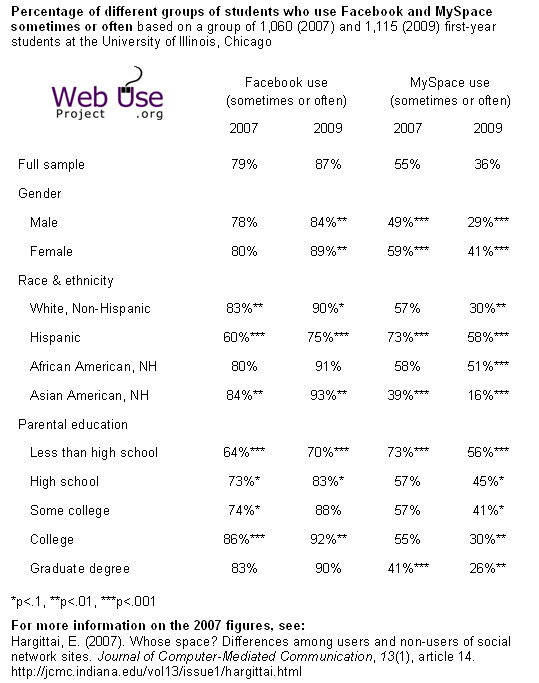
Administering a paper-pencil survey on a diverse group of over a thousand first-year college students at the University of Illinois, Chicago in 2007, we found that men are significantly more likely to share their creative output online than women. This was especially true for video (with 40% of men sharing such content compared to 15% of women), but holds for the other types of material as well.
Curious to see what explains these differences in sharing, we looked at whether various measures of Internet experience account for the divergences. We controlled for years of use, frequency of Internet use, number of Internet access locations, and online skill. Of these four, skill was a significant predictor of sharing activity. In fact, once skill is in the model, gender is no longer a significant predictor of posting one’s material.
There may be additional issues going on for which, I’m afraid, we have no data. For example, women may be more concerned about privacy issues or the critiques their content may receive. I’m working with another student on doing some qualitative follow-up work on this aspect of the question.
There are some more details in a press release Northwestern put out about the study or feel free to send me a note for a copy of the full paper.

If you have some time to kill or need to introduce someone to Internet memes then take a look at this timeline. [Link no longer works.] Zoom in for some of the less visible videos. Any of your favorites missing?
UPDATE: Well, that didn’t last long. A commenter notes that the page is no longer accessible. Here is a screenshot. Use of Dipity for this was interesting since showing all this on a time line adds something to the list.
A propos the discussion of CVs for academics going on the job market, I’ve been meaning to post about the importance of having some Web presence, especially a homepage one maintains with information about one’s work.
I’ve been continually surprised over the years about how many academics fail to take advantage of the Web as a medium for disseminating their work. This seems especially important in the case of those actively seeking a job in the near future.
Whenever I go to a conference, I’m on the lookout for students doing interesting work. Recently, I saw a few impressive presentations and wanted to follow up by learning more about these students. I know we’ll be hiring next year and I wanted to share information about these potential candidates with my colleagues. I looked them up online so I’d have more to go on. Nothing. This is an opportunity missed.
What should a basic homepage include? It should have information that a CV would contain, but the nice thing about a Web site is that it can easily include additional information. In the least, abstracts of published papers would be helpful. Of course, most helpful is to have full copies of these papers. While copyright issues may arise, preprints are almost always okay to post.
Although I don’t encourage students to post too many details about papers not yet accepted for publication, it is possible to mention one’s areas of interests and expertise and that will give visitors a better sense of one’s work than no information whatsoever.
More here on what went into creating it. I love the care with details like the cursor and the stars.
I should be prepping for class, but I want to add an alternative perspective to a question raised about Google’s popularity. The Freakonomics blog features an interesting Q&A with Hal Varian today, I recommend heading over to check out how Google’s chief economist answers some questions submitted by readers last week.
The Official Google Blog takes one of the questions and posts an expanded response to it. The question:
How can we explain the fairly entrenched position of Google, even though the differences in search algorithms are now only recognizable at the margins?
Varian addresses three possible explanations: supply-side economies of scale, lock-in, and network effects. He dismisses all of these (see the post for details) and then goes on to say that it’s about Google’s superior quality in search that makes it as popular as it is.
I don’t buy it, especially the dismissal of the lock-in factor. While I realize that it seems as though another search engine is just a simple click away (and sure, technically it is), I have observed too many Internet users in my research to know that in reality it is not that simple at all. First, there is the lock-in that comes from having Google as the default search engine in some browsers (e.g., Firefox). Of course, related issues apply to other search engines as well. Why does Yahoo! still enjoy a sizeable market share in search at least in the U.S. one might ask? It is probably related to the fact that more people seem to have a personalized version of Yahoo! as their start page in their browsers than any other customized starting page. Or maybe it is because Yahoo! also offers sufficiently good search results.
This then leads us to another issue: the assumption that users carefully consider or realize that there are differences in what search engines return in response to their queries. There is room for much more research here (some of it one of my students may pursue soon), but based on what we know so far, some people tend to have a tremendous amount of trust in results presented by Google. One could say this is due to Google’s superior quality, but research has found that even when results are manipulated and the less relevant ones are offered up on top, some users will click on them presumably because they believe them to be the most relevant. (I’d really like to see that study replicated on users of other search engines to see how this compares across services. Also, additional tweaks to that study design could help us learn more about these issues.)
We still have a lot to learn about the extent to which users actually consider the quality of search engines when using them. Presumably as long as they find (or think they have found!) what they are looking for they will be satisfied. However, again, research (e.g., here, with more in the works) suggests that some users are very bad about assessing the quality of the material that shows up on pages linked from search engine results, which then puts into question their ability to evaluate search engine results quality.
I am not suggesting that Google is not a good search engine nor am I even suggesting that it is not necessarily the best search engine (although how one defines quality in this domain is tricky). I would love to see some really careful studies on this actually. What I am suggesting is that equating market share in searches should not be confused with quality of search results. I know that there are some very talented folks at Google working on search quality some of whom I know and with whom I have had very interesting and helpful conversations. I’m grateful for the work that they do. Nontheless, that’s a different issues. My point here is that I would not dismiss lock-in factors and others in explaining the service’s popularity based on what my research has taught me about how people use search engines.
I have to add one more note here as it is related and it is something I have been trying to insert into discussions of this sort for years. It may be helpful to remember that most search engine market share data look at proportion of searches not proportion of searchers. Since power users are more likely to be Google users (various data sets I work with supply evidence for this), I suspect that if we were to look at market share based on user figures Google’s share would be smaller than it seems based on figures about proportion of searches. I’ve been commenting on this for years, but the statistics that continue to be discussed concern searches not searchers. Of course, both figures may be relevant, but which one is more relevant depends on the particular questions asked. When discussing quality, it seems that proportion of users would be just as important to consider (if not more) than proportion of searches since presumably all users would want to use the highest quality search engine. Point being, if Google is so superior and that explains its popularity then why doesn’t it have a much larger market share especially regarding proportion of users?
UPDATE: Before trying to explain Google’s popularity today with why people turned to it in the earlier part of this decade, I think it’s worth noting that the Web of 2008 is very different from the Web of 2001/02 when people started migrating over to Google in masses. Explaining that trend doesn’t necessarily say much about why people may stick with it today and what, if anything, would inspired them to try a new service now.
UPDATE 2: Perhaps worth noting here is that I think of “lock-in” not in the completely restrictive sense of the term. Of course, I know that there is no technical lock-out from other options, my point was that given how people use the Internet for information seeking, something similar is going on nonetheless
As far as I know, no one has tagged me with this blog meme, but I’m still going to participate as it looks fun.
Instructions:
1. Grab the nearest book (that is at least 123 pages long).
2. Open to p. 123.
3. Go down to the 5th sentence.
4. Type in the following 3 sentences.
5. Tag five people.
Nearest book as I sit at my coffee table at home: The Chocolate Connoisseur by Chloé Doutre-Roussel. Page 123 is in the middle of Chapter 6 on The Cream of the Crop under the Reading the Ingredients List subheading. Here we go:
There are several grades of chocolate, and these figures show the European Union and US regulations for standard (S) as well as fine (F) chocolate.
* Dark chocolate (S) must contain at least 35% dry cocoa solids (but 15% for “sweet chocolate” in the US), while dark chocolate (F) must contain at least 43%.
* Milk chocolate (S) must contain at least 25% dry cocoa solids (but 20% in the UK, and 10% in the US), while fine milk chocolate must contain at least 30%.
The fun continues in the 4th sentence so allow me to add that: “Bars such as Cadbury Dairy Milk, Galaxy or Hershey must be labelled ‘family milk chocolate’ in the EU, as they don’t contain enough chocolate to count as chocolate under these rules!”
So yes, it’s worth noting that chocolate is not immune to policy considerations. It may sound silly, but it’s obviously a huge industry and what gets to be labelled chocolate does have regulations attached to it, ones that vary from one country to the next. There are also lobbying efforst involved. I don’t follow this area closely, but when a related news story pops up, I do find it intriguing to check out.
Since I wasn’t tagged for this meme, I guess I don’t have to tag anyone else either although I invite people to grab the nearest book and post the specified three sentences here or on their own blogs.
Whoa, I guess I won’t be reading any blogs (or emails for that matter) today.
Here is my schedule:
8:30am - Breakfast with job candidate
10am-noon - 4 one-on-one meetings with students one after the other
noon-1pm - Attending job candidate’s talk
1:30-7pm - 11 one-on-one meetings with students (straight through, obviously)
7pm-? - Dinner with colleagues and job candidate
So yeah, this many meetings is not usual, but I thought the students from my undergraduate writing seminar would benefit from some one-on-one discussions of their research statements.
Just another 12+ hour day. Wish me luck.
This video was posted on YouTube just yesterday and has already been watched over 150,000 times.* There’s also a site for a ringtone.
It’s impossible to know at this point how such viral campaigns might influence outcomes, but it’s certainly interesting to watch how people are taking advantage of new tools to disseminate material of this sort. It would be a stretch to suggest anyone can do this easily since this video is filled with celebrities, which likely helped it get coverage on ABC yesterday [source]. Nonetheless, having it available online certainly helps in spreading it widely. I’d be curious to know how most people linking to it found it, but many don’t seem to be pointing to sources, which makes this difficult to decipher.
[*] Note that YouTube’s numbers are confusing as depending on when I click on the link I either get around 153,000 or 84,000 views.
[thanks to Discourse.net]
I didn’t get a chance to blog about my trip to Budapest a month ago. I had a really great time and took lots of photos so if curious then click through to my Flickr set on it for some beautiful architecture and some great food. The links below are just a small sampling and not necessarily of the best shots since it would’ve been too much work to customize the mosaic in that way.
1. Santas on motorcycles, 2. Santas on motorcycles, 3. Get Off Signal sign, 4. Opera, 5. Street lights, 6. Mini telephone booth, 7. Basilica, 8. Old building, 9. O utca, 10. Train station by Eiffel, 11. Train station by Eiffel, 12. Heroes’ square, 13. Art Museum, 14. Heroes’ square, 15. Museum, 16. Men’s restroom sign, 17. Women’s restroom sign, 18. Fried mushrooms, 19. Hortobagyi palacsinta, 20. Chicken (with roasted garlic), 21. Gundel palacsinta, 22. Museum, 23. Women’s restroom sign, 24. Men’s restroom sign
Created with fd’s Flickr Toys.
I didn’t mention Halloween here this year as I was just wrapping up a two-week four-stop trip, but I’ve come across something that I’ll link to regardless of the date: an awesome costume that I may just have to replicate next year. For additional Halloween geeky goodness, check out this Death Star pumpkin.
As I mentioned earlier, I gave a talk at Harvard Law School’s Berkman Center for Internet and Society the other day. The folks at Berkman have kindly posted a video of the talk and discussion. Some interesting issues came up in the Q&A leading to an engaging conversation so I recommend that part in particular. (The talk itself was relatively short, less than 25 minutes, followed by over half an hour of discussion.)
A few weeks ago the Berkman Center for Internet and Society posted an interesting contest: create a short informative video about Web cookies and have the chance to win up to $5,000 and a trip to DC where the video would then be shown at the FTC’s Town Hall workshop on “Ehavioral Advertising“.
I’m afraid we’re past the deadline for submissions and I apologize for posting about this so late (life intervened and I got behind on a bunch of things). I wanted to post about it nonetheless, because I think it’s an interesting initiative and the resulting videos are available for viewing.
I was very intrigued by this contest given my interest in improving people’s Internet user skills. What would be a good way to communicate the concept of a Web cookie to folks who have little technical background? I haven’t looked at all of the submissions, but the ones I’ve seen I find are still too technical and are likely only comprehensible to those who already know at least a few things about Internet cookies. Alternatively, the clips are too vague and so likely have limited utility for that reason. I was a bit surprised and disappointed that people didn’t do more with the cookie analogy. Some of the videos have related cute/amusing components, but not incorporated in a particularly effective way. However, note that I have not watched all of the submitted videos so I may have missed some gems. Feel free to post links to ones you think are especially informative. I think the timeline for submissions was a bit short (I know there were particular logistical reasons for this), which may have prevented more people from getting involved and may have limited the amount of effort that could go into creation of the entries.
An interesting aside about how YouTube posts videos (assuming I understand this correctly, but I haven’t explored this aspect in depth so feel free to correct me): it seems that the creator of the video has little say over what becomes the thumbnail image for the clip. As far as I can tell, the frame is taken from the middle of the video, which is not always ideal as it’s not necessarily the most informative segment.
Before I get evacuated (not a completely crazy idea with the sheriff right outside my office), I thought I’d post just how quickly fire can spread depending on the circumstances.

I realize those are not on the same scale, but the surrounding trees should help identify the areas. Understand that I was just trying to do some work this afternoon and then headed out periodically to take some pictures. I didn’t set up shop for a sequence.
The distance between the fire and the nearest road is quite big so eventually the firetrucks just had to head up on the hill. By the time I finished taking photos that entire patch was dark although it looked like the flames had subsided. Of course, that’s just the part I can see, chances are there is lots of action invisible to me from here.
Now I’m going to try to get back to work, helicopters notwithstanding.
It’s been a looong time, I know. So here is a short list of very random thoughts.
1. Is it weird if someone on Flickr classifies you as family even though you’re not (and this person is also not a close friend)? I’m thinking, perhaps the person clicked on the wrong button.
2. Has anyone else lost their Quick Contacts section in GMail? I don’t have that option anymore, using Firefox of IE. * sniff *
3. Anyone use Virb? Is it the next big thing?
I’ve been doing lots of fun things recently much of which I’ve documented, of course.:)
So here are some links to photo sets on Flickr. I also link to the slideshow version. I think those work best if you tweak the timing to no more than 2 seconds per image, just slide the bar in the upper right corner of the tool.