links for 2009-05-06
May 6th, 2009-
interesting discussion of the potential of this new computational knowledge engine
-
"The Premier Starting Point & Destination for the Black Community"

Kudos to my brother, Balázs Hargittai, for winning not one, but two campus-wide awards at his university this year! Seriously, even one would be a very notable achievement, but two? Wow!
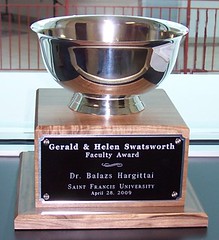
The Gerald & Helen Swatsworth Faculty Award
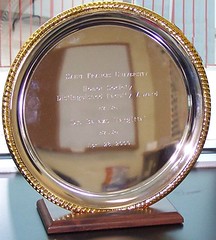
The Saint Francis University Honor Society Distinguished Faculty Award
The following should be really neat. Today at 3pm ET, the Berkman Center will host a sneak preview of the Wolfram|Alpha search engine or “computational knowledge engine”. I saw a preview of it by Stephen Wolfram a month ago at Foo Camp East and was mesmerized. Stephen Wolfram will be talking about the system with Jonathan Zittrain at today’s event. Join the live Webcast, participate remotely using the Berkman Center question tool, by interacting with its Twitter account or on IRC.
UPDATE (4/29/09): The video of the session is now available here.
It started last night: links showing up on Twitter and elsewhere to articles about how Facebook users do worse in school. It’s not hard for people then to jump quickly to the conclusion that Facebook use results in worse grades (e.g., Study: Facebook Hurts Grades). Unfortunately, I know of no data set out there that could help us answer that question. The few people who have relevant data sets could establish correlation at best. I myself have not found such a connection in my data, but let’s back up a bit.
Reading the press coverage about this recent study from a researcher at Ohio State and one at Ohio Dominican University, it’s difficult to get enough information to offer a careful critique. All we’re told is that the findings concern “219 U.S. undergraduates and graduates“, but no idea as to how they were sampled or how the survey was administered. Additionally, there is no detail given in these articles as to how either Facebook use or grades were measured. Is this good and responsible reporting? Hardly.
Doing a search on the AERA’s annual meeting Web site for study author Aryn Karpinski brings up the abstract of the paper “A Description of Facebook Use and Academic Performance Among Undergraduate and Graduate Students”. It’s reasonable to assume that this is the study upon which the press coverage is based as the articles mention AERA. The abstract for a poster to be presented this Thursday reveals a bit more information about the study than the press coverage: a survey was administered to 71 undergraduate and 43 graduate students. It’s not clear how that adds up to 219 respondents as per the press coverage. Perhaps this is the wrong abstract, but I don’t see anything else that would fit the description better. Perhaps the study has been updated since the abstract was initially submitted. Nonetheless, this doesn’t help with transparency about the project.
The abstract suggests that the study is comparing the GPA of users vs non-users without regard to amount of time spent online. Comments by Karpinski in the press coverage, however, suggest measures of amount of time spent on the site: “Our study shows people who spend more time on Facebook spend less time studying.” Of course, it wouldn’t be the first time a researcher gets misquoted in the press so not clear if the researcher really said this (or perhaps the abstract doesn’t include everything that’s covered in the piece). Alternatively, “more time†here is simply meant to refer to “any time at allâ€, not exactly how I’d talk about having “any use” data, but I guess technically any use is more than no use. Point being, we’re not any closer to understanding the study’s scope and the extent to which we should put much faith in its findings.
Having done related work, I didn’t recall any such relationship between Facebook use and grades so I went back to my data set this morning to check. Indeed, based on data about 1,060 first-year students at the University of Illinois, Chicago collected on a paper-pencil survey in Winter, 2007 (data set described in detail here), I find no relationship between whether someone uses Facebook and self-reported GPA (collected in categories, not in specific grade-point average terms). Additionally, I also have data on number of times the respondent used a social networking site the day before taking the survey and there is no correlation between that measure and grades either.
It is also worth noting that an important finding of my study was how Facebook use is not randomly distributed among participants (e.g., parental education, race, ethnicity predicted adoption) so it’s helpful to look at the relationship of various factors such as grades (or whatever else) to Facebook usage while controlling for other variables.
There are lots of reasons why one may or may not find a relationship between Facebook use and grades. I won’t get into that here, it could make for a very long essay. The point of this post is mainly to suggest a careful approach to what we see in the press and at conferences.
A caveat: I woke up this morning with a million immediate things to do and happy that I’d finally get to do them. Then I realized this story had kept spreading since last night and some people asked me to blog about it. I may have missed some relevant resources in my search for background material and others may show up after I post this. Feel free to post updates below with relevant information.
Too often I encounter the following kind of sentence: “I’m wondering if people could improve their grammar?â€
One of my pet peeves is when people put question marks at the end of sentences beginning with “I wonder ifâ€. I’m always left wondering if the person is wondering about whether they’re wondering. (Of course, chances are they are not, but why the question mark then?) This is an incredibly common mistake for reasons not clear to me.
To clarify: starting a sentence with “I wonder if†usually results in a statement and statements don’t come with question marks. If you want to make it a question, you can say “I wonder: how does one end this sentence?†or “I wonder, should there be a question mark at the end of this sentence?â€, but “I wonder if there should be a question mark at the end of this sentence.†should not end with a question mark, unless you are asking whether it is something you’re wondering about (but frankly, most people won’t be able to help you answer that).